


The “Internal Mileage” of the Track Chain
Track pitch is the most reliable indicator of your undercarriage’s health. Measuring it correctly isn’t just about checking track tension; it is about assessing the remaining service life of your bushings and pins. Excessive pitch elongation is a clear warning sign that internal component contact is failing, leading to the rapid destruction of your drive sprockets
1. What is Track Pitch and Why Monitor It?
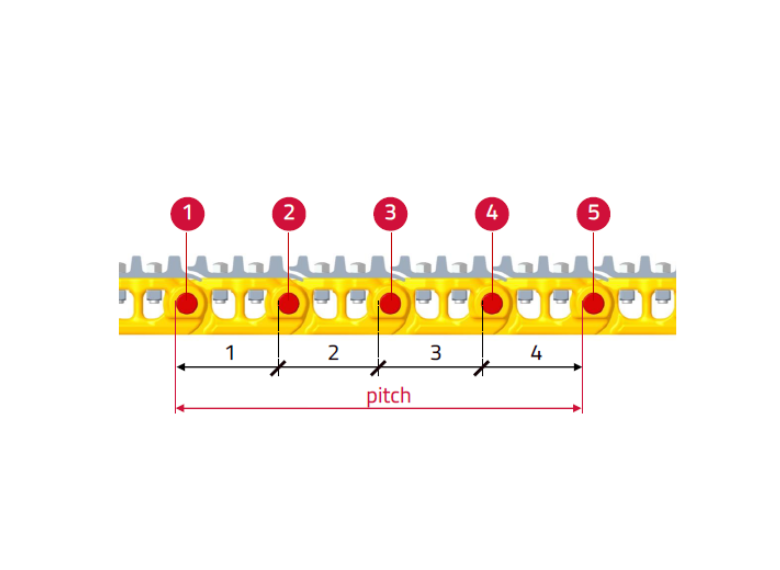
The pitch is the distance between the centers of two adjacent pins. On a new track, this measurement is fixed and nominal. During operation, friction between the pin and bushing wears down the metal, creating play that effectively “stretches” the track.
Why it is vital:
- Synchronization: If the pitch elongates, the sprocket teeth no longer strike the bushing at the correct point, gouging and destroying it.
2. Tools and Preparation
Forget standard rulers for professional measurements. A technical report requires:
- • Vernier Caliper (Precision): To measure the distance between pins.
- • Ultrasonic Wear Indicator (Optional): For advanced technicians.
- • Feeler Gauge or Specific Template: Often provided by undercarriage manufacturers.
Golden Rule: Measurements must be taken with the chain under tension. A slack chain will always yield a false result (lower than actual wear).
3. Technical Procedure: The 5-Pin Rule
To minimize error, never measure a single pitch; instead, take the average across multiple sections.
- 1. Tensioning: move the machine slightly forward and stop without braking abruptly, ensuring the upper section of the track is taut.
- 2. 5-Pin Measurement: place the caliper between the side of the first pin and the corresponding side of the fourth pin (covering 3 full pitches).
- 3. Average Calculation: divide the obtained measurement by 3. Compare the result with the manufacturer’s wear charts (e.g., Berco, ITM, Caterpillar).
- 4. Repetition: Perform the test at least at three different points on the chain to rule out localized wear (e.g., near the master link).
4. Common Mistakes to Avoid
- Measuring a Dirty Chain: Even a few millimeters of packed earth between links can skew the result by 2-3%, which is significant in terms of wear.
- Ignoring OEM Specifications: Every machine model has a different nominal pitch. Do not use generic “standard measurements.”
- Underestimating Elongation: A pitch elongation of even 3% compared to new can mean the chain has already reached 100\% of its service life.
5. Interpreting the Results
- Wear < 25%: Excellent condition
- Wear 50-70%: Ideal time to evaluate extraordinary maintenance.
- Wear > 100%: The chain is “out of pitch.” Replacement is urgent to avoid damaging sprockets and rollers.
Ready to put yourselves to the test? Our technicians are on hand to help – just get in touch.
